
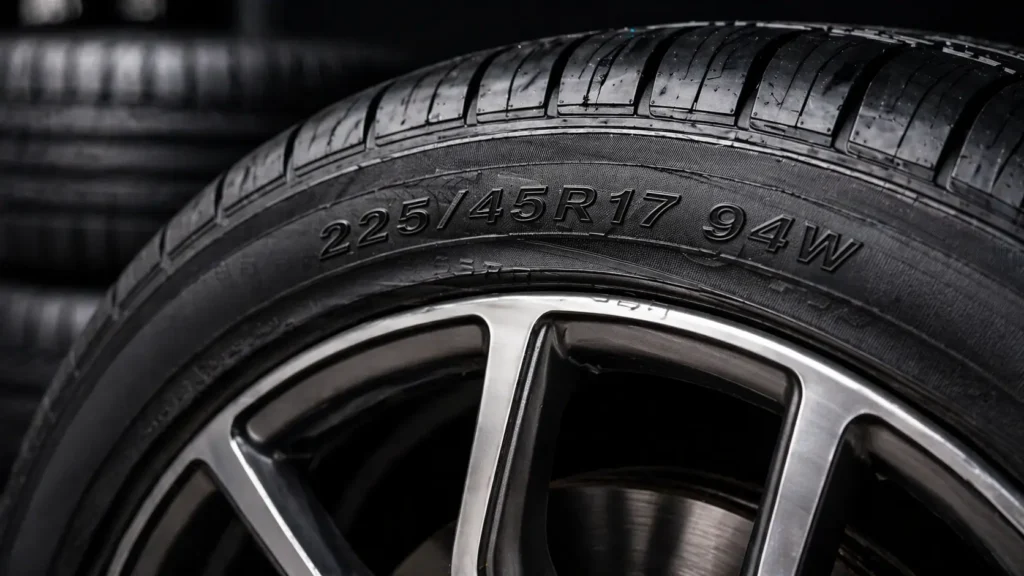
Every tyre has a series of numbers and letters printed on the sidewall. These markings show the size, load capacity, speed rating and construction of the tyre.
For many drivers, codes like 225/45R17 94W can look confusing. But understanding them is essential when replacing tyres, checking compatibility or comparing options.
This guide explains how to read tyre sidewall markings step by step, using simple examples based on UK vehicles.
What Do Tyre Numbers Mean?
A typical tyre marking looks like this:
225/45R17 94W
Here is what each part means:
- 225 – tyre width in millimetres
- 45 – aspect ratio (height of the sidewall)
- R – radial construction
- 17 – wheel diameter in inches
- 94 – load index (weight capacity)
- W – speed rating
These markings help ensure the tyre fits the vehicle correctly and performs safely.
Tyre Size Explained (Width, Profile and Diameter)
The first part of the tyre code is the size.
Example: 225/45R17
1. Tyre Width (225)
This is the width of the tyre from sidewall to sidewall, measured in millimetres.
A wider tyre generally provides:
- More grip
- Better cornering stability
But it may also increase fuel consumption slightly.
2. Aspect Ratio (45)
This is the height of the tyre sidewall as a percentage of the width.
In this case:
- 45 means the sidewall height is 45% of 225mm
Lower profiles (like 40 or 35):
- Give sharper handling
- Provide less comfort
Higher profiles (like 60 or 65):
- Improve ride comfort
- Offer better protection against potholes
3. Construction Type (R)
The letter R stands for radial construction.
This is the most common type of tyre used on modern vehicles.
Radial tyres offer:
- Better durability
- Improved fuel efficiency
- More consistent performance
4. Wheel Diameter (17)
This is the size of the wheel the tyre fits, measured in inches.
The tyre must match the wheel size exactly.
For example:
- A 17-inch tyre cannot fit a 16-inch wheel
Load Index Explained
After the tyre size, you will see a number such as 94.
This is the load index, which shows how much weight the tyre can safely carry.
Example:
- 94 = 670 kg per tyre
Higher numbers mean higher weight capacity.
SUVs and vans often use tyres with load indexes above 100.
Speed Rating Explained
The letter after the load index shows the speed rating.
Example:
- W = up to 270 km/h
Common UK speed ratings include:
- H – up to 210 km/h
- V – up to 240 km/h
- W – up to 270 km/h
This does not mean you should drive at these speeds. It shows the tyre’s performance capability under load.
What Does XL Mean on Tyres?
You may see XL on some tyres.
This stands for Extra Load.
XL tyres are reinforced to carry more weight than standard tyres of the same size.
They are commonly used on:
- SUVs
- Vans
- Heavier passenger vehicles
What Does M+S and 3PMSF Mean?
Some tyres include markings for winter or all-season use.
M+S (Mud and Snow)
Indicates the tyre is designed for:
- Mud
- Snow
- Slippery conditions
3PMSF (Three Peak Mountain Snowflake)
This symbol means the tyre has passed official winter performance tests.
It offers better grip in cold and snowy conditions.
Tyre Manufacturing Date (DOT Code)
Every tyre has a DOT code, which includes the manufacturing date.
The last four digits show the week and year.
Example:
3523
- Week 35
- Year 2023
Tyres should ideally be used within 5–6 years of manufacture, depending on storage and condition.
Directional and Rotation Markings
Some tyres include arrows or labels showing how they should be fitted.
Directional Tyres
Marked with an arrow showing the correct rotation direction.
These tyres are designed to:
- Improve water drainage
- Reduce aquaplaning
Rotation Markings
Some tyres indicate which side should face outward.
Correct fitting is important for performance and safety.
Where to Find the Correct Tyre Size for Your Vehicle
Drivers should not guess tyre sizes.
The correct size can be found:
- In the vehicle handbook
- Inside the driver’s door frame
- On the fuel filler cap
Using the correct size ensures proper handling, safety and legal compliance.
Why Understanding Tyre Markings Matters
Knowing how to read tyre sidewall markings helps drivers:
- Choose the correct replacement tyres
- Avoid fitting incompatible tyres
- Maintain safety and performance
- Compare tyre options more effectively
Incorrect tyre specifications can affect:
- Braking performance
- Fuel efficiency
- Vehicle stability
Common Mistakes Drivers Make
Many tyre issues come from misunderstanding sidewall markings.
Common mistakes include:
Buying tyres based only on price without checking full specifications.
Ignoring load index and speed rating requirements.
Fitting incorrect sizes that affect handling or safety.
Understanding the markings helps avoid these problems.
Quick Summary
Tyre sidewall markings provide all the essential information needed to choose the right tyre.
A code like 225/45R17 94W tells you:
- Width, profile and wheel size
- Load capacity
- Maximum speed rating
Learning how to read these markings makes tyre buying simpler and helps ensure the correct tyres are fitted every time.