
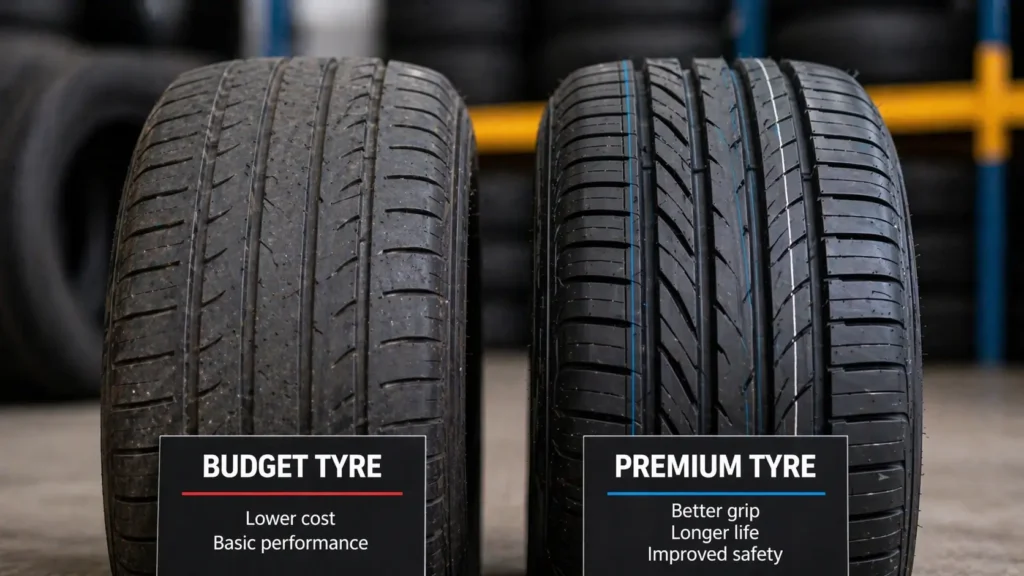

When buying tyres, one of the most common questions is simple: should you choose budget or premium tyres?
The price difference can be significant. Budget tyres are often much cheaper, while premium tyres from major brands cost more. But the real difference is not just price — it’s performance, safety, lifespan and overall value.
Understanding how budget and premium tyres compare helps drivers make the right decision based on driving habits, mileage and road conditions.
Budget vs Premium Tyres
- Budget tyres are cheaper and suitable for low mileage or city driving
- Premium tyres offer better grip, longer lifespan and improved performance
- Premium tyres usually perform better in wet conditions and emergency braking
- Budget tyres can still be safe if they meet UK standards, but may wear faster
For most drivers, the choice comes down to cost vs long-term value.
What Are Budget Tyres?
Budget tyres are lower-cost tyres produced by smaller or less well-known manufacturers.
They are designed to meet minimum legal and safety requirements, but are typically built using:
- Simpler rubber compounds
- Basic tread designs
- Lower production costs
These tyres are widely used because they offer an affordable option for drivers looking to reduce upfront costs.
What Are Premium Tyres?
Premium tyres are produced by established global manufacturers with extensive research and development.
They are designed for higher performance, safety and durability.
Premium tyres often include:
- Advanced rubber compounds for better grip
- Optimised tread patterns for water dispersion
- Stronger construction for stability and longevity
These tyres are commonly fitted as original equipment (OE) on new vehicles.
Key Differences Between Budget and Premium Tyres
1. Grip and Braking Performance
One of the biggest differences is how tyres perform in real driving conditions.
Premium tyres generally offer:
- Shorter braking distances
- Better wet grip
- More consistent handling
In emergency situations, this can make a significant difference.
Budget tyres can still perform adequately, but may:
- Take longer to stop
- Offer less grip in heavy rain
2. Wet Weather Performance
UK driving conditions often involve rain, standing water and slippery roads.
Premium tyres are designed to:
- Disperse water more effectively
- Reduce aquaplaning risk
- Maintain grip at higher speeds
Budget tyres may struggle more in these conditions due to simpler tread designs.
3. Tyre Lifespan
Premium tyres are usually built with higher-quality materials, which helps them last longer.
While they cost more upfront, they often:
- Wear more slowly
- Maintain performance over time
Budget tyres may wear faster, meaning they need replacing sooner.
4. Fuel Efficiency
Rolling resistance affects how much fuel a vehicle uses.
Premium tyres often feature:
- Lower rolling resistance
- Improved fuel efficiency
Budget tyres may have higher resistance, which can slightly increase fuel consumption.
5. Noise and Comfort
Premium tyres are typically designed to reduce road noise and improve comfort.
Drivers may notice:
- Quieter driving at motorway speeds
- Smoother ride quality
Budget tyres can sometimes be:
- Noisier
- Slightly harsher over rough roads
6. Build Quality and Consistency
Premium brands invest heavily in quality control and testing.
This results in:
- More consistent performance
- Better durability under stress
Budget tyres can vary more between batches or models.
Are Budget Tyres Safe?
Yes — budget tyres sold in the UK must meet legal safety standards.
However, meeting minimum standards is not the same as delivering high performance.
In everyday driving, especially at lower speeds, budget tyres can be suitable.
But in demanding conditions such as:
- Heavy rain
- Emergency braking
- High-speed motorway driving
Premium tyres often perform better.
When Budget Tyres Might Be a Good Choice
Budget tyres may suit drivers who:
- Drive short distances
- Mainly use urban roads
- Have older vehicles
- Need a lower upfront cost
For low mileage and low-speed driving, the performance difference may be less noticeable.
When Premium Tyres Are Worth It
Premium tyres are often the better option for drivers who:
- Use motorways regularly
- Drive long distances
- Carry passengers frequently
- Want maximum safety and performance
They are particularly valuable in wet UK conditions, where grip and braking performance matter most.
Cost vs Value: Which Is Better?
While budget tyres are cheaper initially, premium tyres may offer better long-term value.
This is because they can:
- Last longer
- Improve fuel efficiency
- Reduce the need for frequent replacements
In some cases, the total cost over time can be similar.
Mid-Range Tyres: A Middle Option
Between budget and premium tyres, there is also a mid-range category.
These tyres aim to balance:
- Price
- Performance
- Durability
They can be a practical option for drivers who want better quality than budget tyres without paying premium prices.
What Should You Choose?
There is no single answer for every driver.
The right choice depends on:
- Driving style
- Annual mileage
- Budget
- Road conditions
Drivers who prioritise safety and performance often choose premium tyres.
Those focused on cost may choose budget tyres, especially for short journeys.
Common Mistakes to Avoid
When choosing tyres, drivers often:
Focus only on price without considering performance.
Ignore wet grip ratings, which are critical in UK conditions.
Mix different tyre types, which can affect handling.
Taking time to compare options helps avoid these issues.
Quick Summary
- Budget tyres are cheaper but may wear faster and offer less grip
- Premium tyres cost more but provide better performance and durability
- Wet weather performance is one of the biggest differences
- The best choice depends on driving needs and budget
Conclusion
The difference between budget and premium tyres goes beyond price.
Premium tyres offer better grip, safety and lifespan, especially in challenging conditions. Budget tyres provide a lower-cost option that can still be suitable for certain drivers.
Choosing the right tyre depends on how and where the vehicle is used. Understanding these differences helps drivers make a more informed and confident decision.